Average Reviews:

(More customer reviews)After reading the negatives here I was a little wary, but I went ahead and bought it because of the option to play 78s at a reasonable price (so I could digitize my grandparents' 60-year-old home-recorded 78 I've been carting around with me for years). I wanted to use Audacity (freeware) for mp3s instead of Ion's iTunes-related software, and after a few hours of chagrin and web searches I finally got it working right. If I were going for wholesale LP ripping I'd get a sturdier, more professional turntable with more features, but for my immediate purposes I'm happy with it ... now.
Here are a few hints I learned along the way using Audacity 1.2.6 on a Windows XP computer; adjust accordingly for your platform. The list looks long but it's really not that complicated:
- Set the turntable on a very sturdy desk or table. Its light weight invites fluctuation so putting it on a flimsy stand only increases the chance of wobble. If the vinyl you're ripping is warped, weight it down under more albums and books for a few days to help flatten it out.
- Before you connect the turntable, unplug any optional peripherals from the computer, such as external hard drives, using Safely Remove Hardware. (One of my big delays turned out to be a USB conflict, which didn't resolve until I rebooted my computer without the external hard drive connected.) On my setup it works best to record directly onto the computer's hard drive, then transfer the files to an external afterward.
- With the computer turned on, plug the turntable into a USB port (not hub) and wait for the computer to find the right drivers or install them yourself.
- On the Audio tab of the Sound and Audio Device Properties dialog, be sure the Sound Playback device is your computer's audio system, and the Sound Recording device is the turntable. While you're in there, open the Volume sliders for both recording and playback. You'll need them handy when you're adjusting the recording level and if you want to mute your playback while recording.
- Don't start Audacity until after the turntable is ready to go. If Audacity is running before the turntable is plugged in, it won't recognize the turntable.
- On the Audacity preferences menu Audio I/O tab, be sure the device settings are the same as in your Audio dialog. Choose 2 channels. Check the box for Software Playthrough so you can listen while recording.
- On the Quality tab, set the sample rate at 44100 Hz.
- Close all other open programs and don't use your computer for anything else while recording -- nearby vibrations such as typing on the keyboard or even using the mouse on the same table as the turntable can cause unwanted sounds on the recording. It's the tradeoff for using an inexpensive, lightweight turntable.
- After you've recorded the raw file, you can fix noisy, poppy audio with programs from the Effects menu such as Click Removal, Noise Removal and Fade Out. Noise Removal can introduce distortion in quieter parts of the recording, but I found that adding a little Bass Boost to the recording before judiciously applying Noise Removal helped decrease that distortion, and applying Fade Out to the last few seconds helped with the distortion at the end of the recording.
- If your computer doesn't already have a LAME library to export your Audacity files to mp3 (it will tell you if it doesn't), just do a web search for lame_enc.dll, download it, and install it using the Find Library button on the File Formats tab.
(Yes, I'm an amateur audio geek with a mostly unused Broadcasting degree so I love playing with Audacity, but even if you're not, you can too with a little practice.)
For more info, read the Audacity Wiki entry about USB Turntables -- that's where I got some of this.
Hope this helps.
P.S. After using my turntable for a while, I realized that it runs fast, so I double my recommendation to use Audacity if you care about making authentic rips. For my turntable, I use the Change Speed effect at -4.
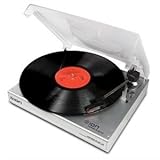
Click Here to see more reviews about: Ion PowerPlay LP USB-Powered Vinyl-to-MP3 Turntable
- Convert LPs to MP3s via USB connection to Mac or PC- Single-cable power and music connection - no power adapter needed- EZ Vinyl / Tape Converter software guides through transfer steps- Requires no external power supply- Plug-and-play USBputer connection requires no driver installationIONPOWERPLAY

Click here for more information about Ion PowerPlay LP USB-Powered Vinyl-to-MP3 Turntable

0 comments:
Post a Comment